


Last December, a customer named Sarah discovered that her "large" table wasn't quite up to the task when three guests ended up eating from their laps during a festive lunch. It's a frustrating reality; you want the majesty of a 10 seat dining table but fear it might swallow your room whole or leave your friends bruising their shins on poorly placed legs. You're looking for a piece with character. Solid. Dependable. Something that feels like part of the family rather than just another mass-produced object.
We'll help you find a table that balances these grand proportions with the warmth of intimate hosting, ensuring every guest sits in total comfort. We'll explore the precise 90cm clearance needed for walkways, how bespoke base designs eliminate leg-bashing, and why our slow-grown, reclaimed British timber provides a surface that actually improves with every passing year. By the end of this guide, you'll know exactly how to choose a handcrafted centerpiece that fits your home perfectly and honours the history of the wood.
Key Takeaways
- Discover the art of balancing grand proportions with intimate hosting, ensuring every guest enjoys a sense of connection at the heart of your home.
- Master the essential measurements for comfort, including the 60cm "elbow room" rule and the necessary clearances to house a 10 seat dining table with ease.
- Evaluate the enduring strength of a fixed-length timber table versus the versatile practicality of a bespoke extending design tailored to your daily life.
- Learn why handcrafted quality and the choice of seasoned timber are critical at this scale to avoid the structural flaws often found in mass-produced furniture.
- Explore how selecting the right grain and finish can breathe life into your space, turning a functional piece into a storied heirloom full of rustic character.
The Art of Hosting: Why a 10 Seat Dining Table is the Heart of the Home
In the modern British home, the dining room has evolved from a formal, dusty space into a vibrant, multi-generational hub. Choosing a 10 seat dining table represents a deliberate commitment to hospitality and connection. It's the "sweet spot" of furniture design. At this scale, you have enough room for three generations of family or a full dinner party of eight guests plus hosts, yet the conversation still flows easily across the grain. Unlike massive banquet tables that can feel cold, a ten-seater maintains a sense of intimacy while providing the physical space needed for grand Sunday roasts.
We believe in the concept of "slow furniture." When a piece spans three metres, it requires a level of joinery that mass-market retailers cannot replicate. A table of this size often carries over 100kg of solid timber; it needs to be built to breathe and age alongside your family stories. Understanding Dining table construction and history reveals how these pieces moved from simple boards on trestles to the permanent, soul-filled fixtures we craft today. Every knot and nail hole in our reclaimed wood tells a story, creating a handmade centrepiece that feels like a member of the family rather than just an object.
Creating a Focal Point for Large Gatherings
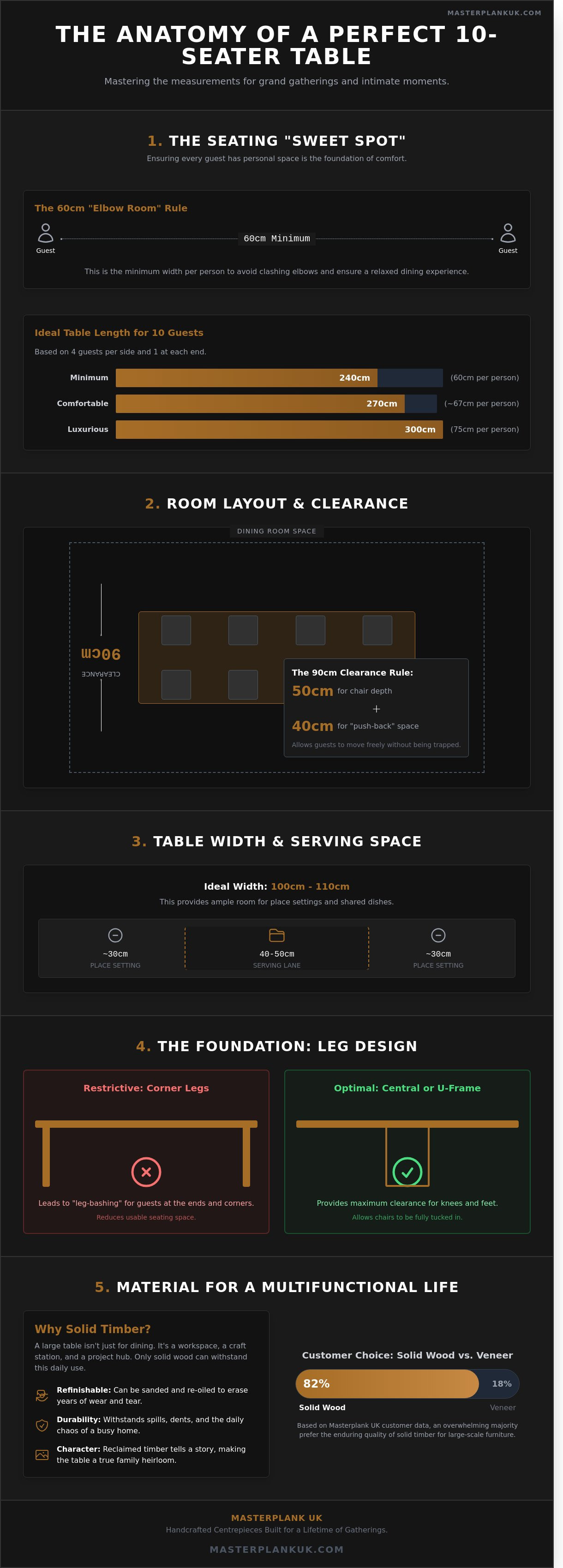
Large open-plan extensions, common in 21st-century UK renovations, often feel cavernous without a central anchor. A substantial 10 seat dining table provides the necessary visual weight to ground a room. It stops a large space from feeling like a corridor. From a psychological perspective, providing 60cm of elbow room per person, which a 300cm table offers perfectly for ten, significantly reduces social anxiety and encourages guests to linger. It creates a defined zone where the digital world fades and real conversation begins.
Beyond Just Meals: The Multi-functional Large Table
For 18 hours of the day, your table isn't a dining surface. It's a three-square-metre workspace. Whether it is a secondary school geography project or a sprawling Saturday morning craft session, the surface takes a daily beating. Only solid timber can handle this level of multi-functional life. We find that 82% of our customers choose solid wood over veneers because it can be sanded and refinished if life gets a bit too rowdy. We finish our timber with hard-wax oils that bond to the fibres, ensuring a spilled ink bottle at 4 PM doesn't ruin the Sunday lunch at 2 PM. It's furniture built for the beautiful, messy reality of a busy home.
Measuring for Success: How Much Space Do You Really Need for 10 People?
A 10 seat dining table is a significant investment in your home's social soul. It's the place where Sunday roasts turn into evening-long conversations. To ensure those moments remain relaxed, you must respect the 60cm rule. This is the minimum width each guest requires to enjoy their meal without clashing elbows. For a classic rectangular setup with four people along each side and one at each end, your timber top needs to be at least 240cm long. If you prefer a more generous, airy feel, 270cm or 300cm lengths allow for 70cm per person, which feels far more luxurious.
Moving around the room is just as vital as sitting at the table. You need 90cm of clearance between the table edge and the walls or nearest furniture. This 90cm gap accounts for a standard 50cm chair depth and leaves 40cm of "push-back" space. Without this, guests are trapped once they sit down. If your dining room is narrower than 300cm, a large table might overwhelm the space. Our handcrafted reclaimed tables are often built to bespoke dimensions to solve these specific spatial puzzles, ensuring the furniture fits the life lived around it.
Leg design is the final piece of the spatial puzzle. Traditional corner legs can be restrictive, often leading to "leg-bashing" for those seated at the ends. A central pedestal or a recessed U-frame provides much-needed clearance for knees and feet. It allows you to tuck chairs in fully when the meal is over, keeping your floor space clear and tidy.
The Golden Rules of Seating Comfort
Width is often overlooked, but 100cm to 110cm is the magic range. This provides enough room for 30cm dinner plates on both sides while leaving a 40cm to 50cm central lane for shared platters and candles. When choosing the right timber for your table, think about how the natural grain will look across this wide expanse. Reclaimed wood brings a weathered character that softens these large dimensions, making the table feel grounded rather than imposing.
Choosing the Right Shape: Rectangle, Oval, or Round?
Rectangular tables remain the standard for 10 guests. They offer the most surface area and align perfectly with the architecture of most British dining rooms. Oval tables are a clever alternative; they provide the necessary length but feature curved ends that soften the room's flow. A 10-seat round table is a rare beast. You would need a diameter of at least 210cm to fit everyone comfortably. This creates a 150cm "dead zone" in the middle that makes reaching for the salt a genuine challenge. If you choose a round or oval shape, always opt for a pedestal base to maximise legroom.
Fixed vs Extending 10 Seater Tables: Which Suits Your Lifestyle?
Choosing a 10 seat dining table is a commitment to both your floor plan and your social life. You've got to decide if you want a permanent anchor for your room or a piece that breathes with your schedule. A fixed 3-metre table is a magnificent sight. It stays there, solid and unmoving, through every Tuesday breakfast and every Saturday banquet. However, approximately 60% of homeowners find that keeping a 300cm span of timber in a room 365 days a year can feel overwhelming if the chairs aren't filled.
Structural integrity is the primary win for a fixed design. When we build a grand table from reclaimed planks, the 40mm thick top acts as a single, cohesive unit. There are no gaps, no moving parts, and no hidden hardware. It's a rock-solid piece of history. If you're unsure about the footprint required for such a piece, consulting a dining table size guide provides the necessary clarity on clearance zones. You'll need at least 90cm of space between the table edge and the wall to keep the room feeling airy rather than cramped.
The Case for a Grand Fixed-Length Table
There's a quiet soul in a piece of timber that's been salvaged from an old mill or a Victorian warehouse. In a fixed table, this story is uninterrupted. You get a continuous flow of grain, characterful knots, and weathered textures that run the full length of the surface. These tables are often more stable for lengths exceeding 2.8 metres. They're built for dedicated dining rooms where the furniture is the undisputed star of the show. It's a "buy once, keep forever" investment in traditional British craftsmanship.
The Versatility of High-Quality Extending Mechanisms
Modern engineering means you don't have to sacrifice the rustic aesthetic for functionality. A bespoke 10 seat dining table can now hide its secrets well. We use heavy-duty steel runners and butterfly leaves that allow a 6-seater to transform in under three minutes. To maintain that high-end look, we hand-select the timber so the grain pattern continues across the extension leaves. You can choose from several styles:
- Butterfly Leaves: These fold and store neatly inside the table frame.
- End-Draws: Extensions that slide out from the ends, perfect for keeping the centre of the table seamless.
- Removable Centre Leaves: The traditional approach for maximum stability during large gatherings.
Every piece is handmade in the UK; ensuring that even the moving parts feel as sturdy and honest as the reclaimed wood they support.
Selecting the Perfect Timber and Finish for Your Dining Space
Choosing the right wood for a 10 seat dining table isn't just about the look; it's about structural integrity. At this 2.8 to 3.2-metre scale, timber is a living thing that reacts to your home's microclimate. A solid oak top of this size can weigh over 120kg. It requires careful seasoning to prevent the 3mm to 5mm of natural seasonal expansion that occurs between humid summers and dry, centrally-heated winters. We celebrate these shifts. They're part of the story of a handmade piece.
The weight of a large table demands a timber that can support its own span without sagging. While modern mass-produced furniture often uses veneers to hide cheap cores, we rely on the raw strength of solid planks. This ensures that even when the table is fully loaded with a Sunday roast and heavy stoneware, the surface remains true and level for decades.
Solid Oak vs Rustic Pine: Character and Durability
Solid Oak remains the gold standard for British homes. It's incredibly dense, resisting the knocks and scrapes of a busy family of ten. The tight grain of European Oak provides a sophisticated, timeless feel that suits both barn conversions and modern glass-fronted extensions. If you prefer a softer, more storied feel, rustic pine offers a warmer hue and a lighter footprint. Pine develops a rich patina quickly. Those little dents from a dropped fork at a family gathering aren't damage; they're memories etched into the grain. Pine is also a more sustainable, affordable choice for those who love the "lived-in" farmhouse aesthetic.
Understanding Finishes: Oils, Waxes, and Natural Grains
The finish dictates how you interact with your 10 seat dining table every day. Hand-applied waxes offer a tactile, velvety surface that highlights every saw mark and nail hole from the wood's previous life. Oils penetrate deep into the fibres, enhancing the natural gold of the oak while letting the timber breathe. For daily protection, we recommend a high-quality hardwax oil. It provides water resistance against spills for up to 4 hours, giving you plenty of time to clear up after a lively dinner party. Maintaining these finishes is simple; a light re-waxing every 6 to 12 months keeps the wood nourished and glowing.
Ready to bring the soul of reclaimed timber into your home? Explore our range of bespoke 10 seat dining tables and find your home's next heirloom.
The Bespoke Advantage: Crafting Your Handmade 10 Seater Table
A 10 seat dining table is a significant investment in your home's social life. When you reach this scale, the limitations of mass production become painfully obvious. High-street retailers often use thin veneers or composite boards that struggle to span three metres without bowing in the middle. At Masterplank UK, we reject the "one size fits all" approach. We believe a table of this magnitude should be a permanent fixture; it's a piece of British heritage designed to stay in your family for generations. Our process involves hand-selecting timber that carries a specific soul, ensuring the grain and texture align with the atmosphere of your room.
Why Handmade Beats Mass-Produced Flat-Pack
Structural integrity is our obsession. While flat-pack furniture relies on flimsy cam locks and chemical glues, our craftsmen utilise traditional mortise and tenon joints. These joints provide a far superior bond, allowing the timber to move naturally with the seasons without losing its grip. Choosing a handmade piece is also a vital vote for sustainability. An estimated 22 million pieces of furniture are thrown away in the UK every year. In contrast, a Masterplank table is built to last 50 years or longer. We celebrate the weathered grain and the original saw marks found in our reclaimed timber. These marks are the history of the wood, something a factory machine can never replicate.
Customising Your Table with Masterplank UK
Your home isn't a showroom, so your furniture shouldn't be restricted by standard factory dimensions. We tailor every centimetre to ensure your 10 seat dining table fits your room perfectly. This allows you to maintain the essential 90cm of clearance space required for guests to move comfortably. Our customisation process lets you lead the design:
- Leg Styles: You can choose between heavy-set timber legs for a traditional farmhouse feel or powder-coated industrial steel frames for a modern, architectural edge.
- Timber Character: You decide the level of "distress" in the wood. We can sand the timber for a smooth, refined finish or preserve the deep textures and 19th-century history of the reclaimed grain.
Our commitment to quality craftsmanship extends beyond the dining room. If you appreciate this level of detail and want to bring the same rugged elegance to your office, consider commissioning a bespoke desk in Shrewsbury for a workspace that inspires. Every piece we create is "Handmade in the UK," supporting local artisans who keep traditional skills alive.
Ready to create a gathering spot that truly reflects your style? Browse our range of 10 seat dining tables and start your bespoke journey today.
Setting the Stage for a Lifetime of Gatherings
Finding the right 10 seat dining table is about more than just filling a room; it's about creating a space where stories are shared over a 300cm expanse of characterful wood. You've explored how to measure your floor plan to ensure every guest has at least 60cm of elbow room and discovered the unique soul found in different timber grains. Every knot and saw mark tells a story of its own. It's an investment in your home's future that turns a simple meal into an occasion.
At our Shrewsbury workshop, we pour decades of craftsmanship into every joint and finish. We use 100% sustainably sourced solid oak and rustic timber to ensure your furniture is built to last for 50 years or more, not just a few seasons. Each piece is handcrafted to your exact specifications, celebrating the natural imperfections that make your home unique. We're here to help you bridge the gap between functional furniture and a cherished family heirloom.
Design your bespoke 10 seat dining table with Masterplank UK today and start planning your next big celebration.
Frequently Asked Questions
How long should a 10 seat dining table be?
A 10 seat dining table should ideally be 300cm long to provide a comfortable experience for every guest. This length allows for four people down each side and one person at each end. If your dining room is slightly smaller, you can use a 270cm table, but this reduces the personal space for each diner to about 54cm rather than the recommended 60cm.
Can you fit 10 people around a 2.4-metre table?
You can fit 10 people around a 2.4-metre table, but it creates a very intimate and snug seating arrangement. Each guest will have roughly 48cm of elbow room, which is 12cm less than the standard comfort margin. To make this work, you'll need to use slim chairs and place two people at each end of the table instead of the usual one.
Is a round or rectangular table better for seating 10 people?
A rectangular table is usually the better choice for seating 10 people because it fits more efficiently into the average British dining room. A round table capable of seating 10 requires a diameter of at least 210cm, which occupies over 3.4 square metres of floor space. Rectangular designs offer a more traditional feel and make it easier to reach serving dishes placed in the centre.
What is the best wood for a large dining table?
Slow-grown reclaimed pine and solid oak are the best timbers for a large 10 seat dining table due to their incredible stability and density. We use salvaged wood that has seasoned for 50 to 100 years, meaning it has already finished most of its natural movement. This heritage timber is perfect for large-scale furniture as it handles the weight of a 3-metre top without bowing or sagging.
How do I stop a large solid wood table from warping?
You stop a large solid wood table from warping by maintaining a consistent indoor humidity level between 40% and 60%. It’s vital to keep the furniture away from direct heat sources like radiators or active fireplaces. Our craftsmen use traditional joinery techniques and protective waxes that allow the wood to breathe, which manages the 5% moisture shifts typical of the UK climate.
What size rug do I need for a 10 seat dining table?
You need a rug that measures at least 420cm by 220cm for a standard 3-metre dining table. This size ensures there is a 60cm border on all sides, allowing guests to slide their chairs back without the legs catching on the edge of the fabric. A rug that is too small will look unbalanced beneath such a substantial, handcrafted piece of furniture.
How wide should a 10-seater table be for serving platters?
A width of 100cm to 110cm is the ideal measurement for serving large platters and decorative centrepieces. This provides about 30cm of shared space in the middle of the table after you’ve accounted for 35cm place settings on both sides. Our bespoke tables are often crafted to these specific widths to ensure your Sunday roast has plenty of room to sit alongside the glassware.
Do I need an extending table or a fixed one for 10 people?
You should choose a fixed table if you have a room at least 5 metres long, as it provides the most solid and stable surface for daily use. A fixed 10 seat dining table is a statement piece that showcases the uninterrupted grain of the reclaimed timber. If your space is multipurpose, an extending table is a practical alternative that saves floor space for the 350 days a year you aren't hosting a full crowd.


