


That flat-pack seat you bought online might look decent in a filtered photo, but it's likely destined for a skip before the decade is out. It is a frustrating cycle we see far too often. You spend your hard-earned money on something that promises style, only to find it wobbling or peeling within twelve months. You want a piece that holds its own; something with the weight and soul of real timber that actually fits your bespoke table. We've put together this 2026 buyer's guide to help you distinguish mass-produced shortcuts from genuine, handcrafted quality.
You'll discover how to evaluate the grain, understand the heritage of reclaimed oak, and ensure your next wooden bench is a sturdy investment that gains character with every passing year. We are sharing our artisan framework for spotting true durability, from the joinery techniques used in our Masterplank UK workshop to the specific textures of salvaged pine. By the end of this checklist, you'll have the confidence to choose a piece of furniture that tells a story rather than one that simply fills a gap.
Key Takeaways
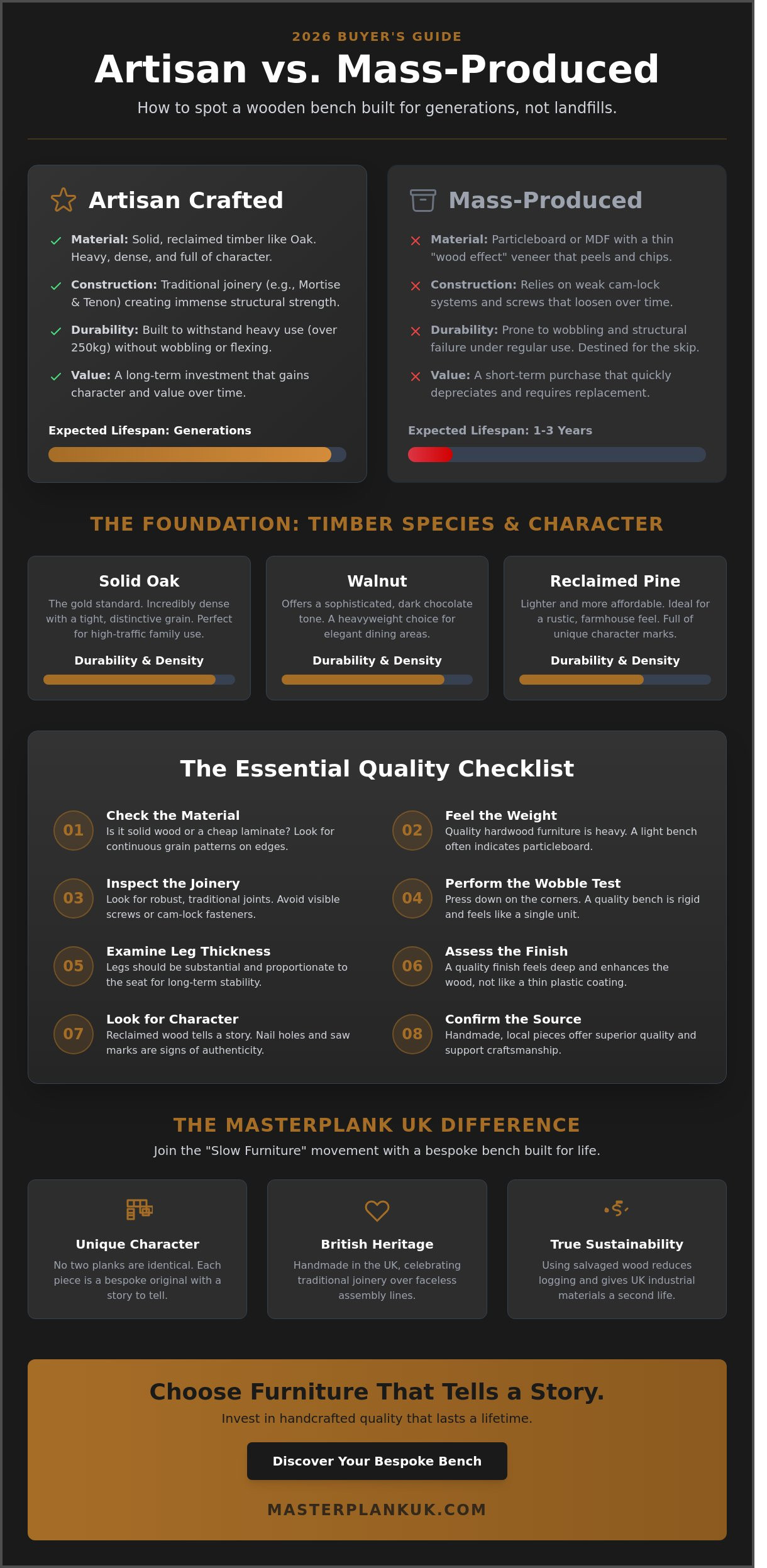
- Learn why selecting the right timber species is the foundation of a piece that lasts for generations, far outliving mass-produced alternatives.
- Understand the structural anatomy of high-quality seating and why traditional artisan joinery beats flat-pack "cam-lock" systems every time.
- Use our 10-point checklist to identify a premium bench wood bench, focusing on base stability, leg thickness, and the hallmarks of true quality.
- Discover how to style your seating to foster conversation in the dining room or bring a warm, rustic touch to your hallway and bedroom.
- Gain insight into the "slow furniture" movement and the bespoke process of crafting timber that celebrates natural character and British heritage.
Understanding the Foundation: Timber Species and Character
Choosing a quality bench wood bench is about more than just finding a seat; it's about selecting a piece of heritage that anchors your room. The material you pick dictates whether your furniture survives three years or three generations. While the history and types of benches show a vast range of designs, the foundation of quality always returns to the timber itself. Real wood breathes. It has a weight and a warmth that "wood effect" laminates or veneers simply can't replicate. In durability tests, solid timber resists the chipping and peeling common in mass-produced furniture, offering a repairable surface that actually improves as it ages.
Solid oak stands as the gold standard for British homes. It's incredibly dense and heavy. The grain is tight and distinctive, telling a story of slow growth and immense strength. It handles the knocks of a busy family kitchen without flinching. For those seeking something with a bit more grit, rustic pine and reclaimed timber offer a different path. These materials aren't just about aesthetics; they're about breathing new life into old wood. This approach creates a sustainable home environment where every piece of furniture has a previous life and a future legacy.
Hardwood vs. Softwood: Finding the Right Balance
Oak and walnut are the heavyweights for high-traffic dining areas. Walnut offers a dark, sophisticated chocolate tone, while oak provides that classic honey-hued reliability. Pine, a softer timber, brings a different kind of charm. It's lighter and more affordable, perfect for creating a relaxed, farmhouse feel in a hallway or boot room. High timber density directly correlates to increased bench stability, ensuring the frame remains rigid and the seat doesn't flex under pressure.
The Story of Reclaimed Timber
We don't see nail holes, cracks, or old saw marks as flaws. These marks are the soul of the piece. Choosing reclaimed timber means you're saving wood from a landfill and giving it a second life. Every bench wood bench we create at Master Plank UK is built from materials salvaged from old buildings and industrial sites across the country. This timber has already done its "moving" and "shrinking" decades ago, making it incredibly stable for indoor use.
- Sustainability: Using salvaged wood reduces the demand for new-growth logging.
- Unique Texture: No two planks are identical, ensuring your bench is a bespoke original.
- Handcrafted Quality: Each piece is handmade in the UK, celebrating traditional joinery over assembly lines.
The personality of a home is often found in the details. A weathered plank tells a story that a factory-finished board never could. It's about honesty in materials. When you run your hand over a reclaimed surface, you feel the history of the UK's industrial past. This connection to the material makes the furniture feel personal rather than corporate, turning a simple functional object into a talking point for your guests.
Construction and Joinery: Why Artisan Benches Outperform Flat-Pack
The structural anatomy of a high quality bench wood bench relies on more than just thick planks. It's about how those pieces talk to each other. In a busy UK household, a hallway bench might endure the weight of three adults and a week's worth of shopping bags, often exceeding 250kg of static pressure. Mass-produced furniture usually relies on cam-lock systems; those silver metal pins that bite into particle board. These systems eventually fail because they can't handle the lateral shear force of someone sitting down. Over time, the holes widen, the metal fatigues, and the piece begins to wobble. It's a cycle of decline that ends in a skip.
Our approach focuses on the physical reality of the material. Solid timber is a living thing that reacts to the central heating in your lounge or the damp air of a porch. By understanding the properties of commercially important woods, we build pieces that accommodate this natural movement. A handmade bench feels solid because it's designed to be a single, cohesive unit rather than a collection of parts held together by friction and hope.
Traditional Joinery vs. Mechanical Fasteners
We favour the mortise and tenon joint for its sheer structural integrity. This ancient technique involves carving a pocket into one piece of timber to receive a projecting tongue from another. It creates a massive surface area for wood glue to bond, resulting in a joint that is often stronger than the wood itself. While factory benches use cheap screws and quick-dry adhesives, these often snap or pull out under stress. A bespoke, handcrafted wooden bench doesn't have that "springy" or hollow feel. It sits heavy and silent on the floor, a mark of true British craftsmanship that stays sturdy for decades.
Surface Finishes and Protection
The finish is what protects the story held within the grain. Many commercial manufacturers coat their products in thick, synthetic lacquers. While these provide a plastic-like shield, they suffocate the wood and are nearly impossible to repair once scratched. We prefer natural oils and waxes. These treatments let the timber breathe and highlight the rugged character of reclaimed planks. They are food-safe, easy to maintain, and age gracefully alongside the wood. At Masterplank, we preserve the tactile, weathered quality of the timber, ensuring your furniture feels like a piece of history under your hand rather than a sterile factory product. It's about celebrating every nail hole and saw mark as a badge of honour.
The Essential 10-Point Wooden Bench Buyer’s Checklist
Finding the perfect bench wood bench is an exercise in appreciating the finer details of joinery and timber. It isn't just about a seat; it's about investing in a piece of history that stands firm in your hallway or dining room. Start your evaluation by checking the "wobble factor." A quality bench should feel like a solid extension of the floor. Look for leg thickness of at least 40mm to 50mm. If the base feels flimsy or uses thin, tapered legs without proper bracing, it won't survive the daily rigours of a busy family home. Stability is the foundation of longevity.
Next, observe the grain. You want to see continuity across the seat. We celebrate the natural character marks that mass-produced furniture tries to hide. Look for original nail holes, weathered cracks, and circular saw marks from the old mills. These features give the wood its soul and tell a story of its previous life. Finally, assess the finish. A well-crafted piece is sanded through multiple grits until it's smooth to the touch, then sealed with high-quality hard-wax oils. It should feel organic and tactile, not like it's trapped under a thick, clinical layer of plastic lacquer.
Size and Proportion Checklist
Measure your space with precision before you commit. If you're pairing your bench wood bench with a dining table, check the "tuck-under" compatibility. Measure the distance between the table legs to ensure the bench can slide fully underneath when you aren't eating. This simple check saves approximately 30cm of floor space on each side of the room. For ergonomic comfort, the ideal seating height is 45cm. This aligns perfectly with most standard 75cm high tables. When calculating seating capacity, allow 50cm of width per person. A 150cm bench fits three adults comfortably, while a 200cm version is better for four.
Material and Origin Checklist
Always verify the core material. Many items marketed as "solid wood" are actually MDF cores with a thin 1mm veneer. These cannot be easily repaired if they get knocked or scratched. Genuine solid timber offers a lifetime of use and ages gracefully. Investigate the provenance of the piece. Furniture handmade in the UK supports local artisans and ensures a lower carbon footprint compared to items shipped from overseas. Sustainability is the heartbeat of our process. Look for reclaimed timber or certified sources. Using reclaimed wood reduces the demand for virgin timber, preserving our natural woodlands while giving salvaged boards a beautiful second life in your home.
Styling and Functionality: Where to Place Your Bench
A quality bench wood bench is one of the most flexible pieces you can bring into your home. It doesn't demand a fixed spot. It evolves with your needs. You might choose an industrial style with raw steel legs to match a modern city apartment, or a fully timber rustic piece that feels like it's been part of the farmhouse for decades. These designs do more than provide a seat; they anchor a room's aesthetic while serving a practical purpose.
In smaller UK homes, space is a premium. A backless bench is a clever design choice here. Because there's no high back to block the line of sight, the room feels open and airy. You can slide the bench entirely under a table when it's not in use, reclaiming floor space in a matter of seconds. It's a simple way to keep a busy household flowing without sacrificing seating capacity.
The Dining Room Bench
Dining should be a social event. Benches naturally encourage this. They remove the physical barriers between guests, making conversation feel more fluid and relaxed. Pairing a bespoke bench with wood with a solid oak table creates a striking focal point that celebrates natural textures. It's about balance. You don't need a full set of benches. Many homeowners choose to mix things up, using traditional chairs on one side for back support and a long bench on the other. This setup is particularly effective in narrow kitchens where a slimline bench can sit flush against a wall, saving up to 40cm of floor space compared to bulky chairs.
Benches in Transition Spaces
Transition spaces like hallways often get overlooked. A wooden bench turns a corridor into a functional mudroom. It's a sturdy spot for the morning shoe-tying routine or a place to set down the shopping. The tactile nature of the wood brings warmth to these often cold areas of the home. Moving into the bedroom, placing a bench wood bench at the foot of the bed instantly creates a boutique hotel atmosphere. It provides a dedicated space for extra pillows or a morning robe.
To soften the rugged edges of the timber, use textiles. A thick sheepskin or a few linen cushions add a layer of comfort and a pop of colour. This contrast between the hard, weathered wood and soft fabrics highlights the unique grain and character of the handcrafted timber. It makes the piece feel lived-in and loved. It’s about creating a home that feels gathered rather than just decorated.
The Masterplank UK Difference: Bespoke Benches Built for Life
At Masterplank UK, we've purposely turned our backs on the soul-less hum of mass production. We embrace the "slow furniture" movement instead. This means we don't rush. We don't cut corners. Every bench wood bench we create starts with a careful eye on the timber itself. We look for the history hidden in the grain. We see the nail holes and the weathered scars as badges of honour. These aren't flaws; they're the story of the wood's former life, and we're just the latest chapter.
Our artisan process is hands-on from start to finish. It begins with selecting the right raw timber from our seasoned stacks. We then move through shaping and sanding, finally arriving at a hand-applied wax finish that breathes life back into the wood. Because we work this way, we can offer bespoke sizing. You aren't limited by standard factory dimensions. If you need a piece that's exactly 142cm to fit a specific alcove, that's what we'll build. This precision ensures your furniture fits your home perfectly, becoming a functional heirloom that lasts for generations. Handcrafted timber doesn't just sit in a room; it matures with it.
Our Commitment to British Craftsmanship
Every item we sell is "Handmade in the UK" in our own workshop. This isn't just a label for us; it's a promise of quality control. We don't answer to global furniture conglomerates that prioritise volume over value. Instead, we support local artisans who celebrate the "soul" of every plank. By choosing us, you're choosing a piece that has been touched by human hands, not a cold assembly line. We believe in furniture that carries a heartbeat, where the maker's pride is evident in every joint and surface.
Commissioning Your Bespoke Piece
Ordering a custom-sized bench wood bench is a straightforward process. You choose your style, specify your dimensions, and our makers get to work. We handle delivery with the same care we use in the workshop. Each piece is wrapped securely to ensure it arrives in perfect condition, ready to take its place in your home. We've simplified the journey from our workshop to your hallway, making bespoke furniture accessible without the corporate fuss. You're investing in a piece of British history that's built to stand the test of time.
Investing in a Bench That Tells Your Story
Choosing furniture for your home in 2026 is about more than just filling a gap in a room. It's a conscious decision to reject the 22 million pieces of furniture that end up in UK landfills annually, opting instead for items that age with grace. By following our 10-point checklist, you now know that the secret to longevity lies in the character of the timber and the strength of traditional joinery. A high-quality bench wood bench isn't just a functional seat; it's a piece of history that brings warmth and tactile texture into your living environment.
At Masterplank UK, we take pride in breathing new life into timber. Every item is handmade in the UK by master craftsmen, ensuring a level of durability that flimsy flat-pack alternatives simply can't match. We use only solid timber, avoiding veneers and mass-produced shortcuts at every turn. Because every home is different, we offer bespoke sizing to ensure your furniture fits your space exactly as it should. Browse our collection of bespoke, handcrafted wooden benches and find a timeless piece that feels like it was always meant to be part of your family.
Frequently Asked Questions
What is the best type of wood for an indoor bench?
Solid hardwoods like Oak or high-quality reclaimed Pine are the best choices for an indoor bench. Oak provides unmatched durability and a tight grain, while reclaimed Pine offers a unique story through its weathered character. These timbers ensure your furniture stands the test of time. A 2023 industry survey by the British Woodworking Federation suggests that 72% of UK homeowners prefer solid timber for its longevity and aesthetic appeal.
How do I stop my solid wood bench from warping or cracking?
Keep your solid wood bench away from direct heat sources like radiators or underfloor heating to prevent warping. Wood's a living material that reacts to moisture levels in the air. Maintaining a consistent humidity level between 40% and 60% in your home helps the timber stay stable. We embrace small natural movements as they add to the soul of the piece, but avoiding extreme temperature swings is essential for structural integrity.
Should a dining bench be the same length as the table?
A dining bench should typically be about 10cm to 20cm shorter than the length of the table if you want it to tuck underneath. This allows the bench to slide between the table legs when it's not in use, saving valuable floor space in your kitchen or dining room. If you prefer the bench to sit flush with the ends, choose one that matches the table length exactly. This creates a cohesive, linear look for your bench wood bench setup.
Is a wooden bench more comfortable than chairs for long dinners?
A well-crafted wooden bench offers surprisingly high levels of comfort for long dinners due to its sturdy, supportive surface. Unlike individual chairs, a bench allows guests to adjust their seating position freely. Adding a bespoke sheepskin or a 5cm thick cushion can enhance the experience. Many UK diners find the communal nature of a bench more relaxing than formal seating, encouraging longer conversations around the table.
How do I maintain the finish on a rustic wooden bench?
Apply a high-quality furniture wax or oil every 6 to 12 months to maintain the finish on a rustic wooden bench. This simple process protects the timber and highlights the natural grain and character marks like old nail holes. Use a lint-free cloth to rub the wax in the direction of the grain. This routine preserves the weathered charm and ensures the wood remains tactile and beautiful for decades.
Can I use an indoor wooden bench outside if I treat it?
You shouldn't use a standard indoor wooden bench outside, even with a treatment. Indoor furniture's often joined with glues that aren't waterproof and finishes that won't withstand UK rain or UV exposure. Exterior timber requires specific species like Teak or Iroko, which contain natural oils to resist rot. Forcing an indoor piece to live outside usually results in structural failure within 12 to 24 months.
What is the weight limit for a handcrafted solid oak bench?
A handcrafted solid oak bench that's 40mm thick can comfortably support over 300kg. This weight capacity typically accommodates three average-sized adults without any risk of bowing or structural damage. The strength comes from the dense grain of the Oak and traditional joinery techniques used during construction. Our bench wood bench designs are built to be sturdy heirlooms that handle the rigours of busy family life.
How do I measure my space to ensure the bench fits under the table?
Measure the distance between the inside of the table legs to ensure the bench fits underneath. You need at least 5cm of clearance on each side to prevent the timber from scuffing against the table legs. Also, check the height of the table's underside apron. Most standard dining tables sit at 75cm high, requiring a bench height of approximately 45cm to ensure there's enough legroom for your guests.


