


Last November, a homeowner in Bristol watched their "oak-effect" table peel after just 14 months of use, a £550 mistake that ended up in a skip. It's a frustratingly common tale, especially as 64% of UK furniture shoppers in 2025 reported confusion over what "solid wood" actually means. You deserve a piece that breathes with your home and handles the hum of central heating without a shrug. We believe your furniture should be an heirloom, not a disposable item that loses its lustre the moment you get it through the door.
This guide reveals how to identify true craftsmanship and choose a Solid Oak Dining Table that perfectly matches your home's unique character. We'll walk you through selecting bespoke dimensions for those awkward UK dining rooms and show you how to maintain the timber's natural beauty for decades. From grain patterns to joinery, you're about to gain the confidence to invest in a handcrafted piece that truly tells a story.
Key Takeaways
- Understand the vital distinction between full stave and finger-jointed timber to ensure your table boasts the seamless visual flow of high-quality craftsmanship.
- Learn how to choose a Solid Oak Dining Table that harmonises with your home's unique character, from weathered rustic styles to raw industrial designs.
- Master the "golden rule" of dining room clearance to ensure a comfortable seating arrangement for everything from intimate 4-seaters to grand 12-seat extending tables.
- Discover the soul behind the timber by exploring our bespoke commissioning process, where every piece is sustainably handcrafted in our Shrewsbury workshop.
Why a Solid Oak Dining Table is the Heart of a British Home
The British home revolves around the kitchen and dining area. It's the space where Sunday roasts are served, late-night conversations happen, and children finish their homework. In this setting, a Solid Oak Dining Table isn't just a piece of furniture; it's an anchor for family life. Over the last decade, we've seen a significant shift in how people furnish their homes. The 2023 British Furniture Manufacturers report highlighted that 35% of UK buyers are now prioritising "lifetime" pieces over disposable alternatives. This move towards the Slow Furniture movement represents a rejection of the flat-pack culture that has dominated since the late 1990s.
Investing in solid timber is a choice for the future. Unlike mass-produced items made from composite materials, oak possesses a natural resilience. The unique properties of oak wood, including its high density and natural tannin content, make it incredibly resistant to the knocks and spills of a busy household. While a cheap table might look tired after twenty-four months, a well-crafted oak piece develops a rich patina. It appreciates in character. You aren't just buying a surface to eat on; you're securing a family heirloom that will likely be passed down through generations.
Sustainability is at the core of this choice. When you choose a Solid Oak Dining Table handcrafted in the UK, you're drastically reducing the carbon footprint associated with your furniture. Many high-street retailers ship their products from Asia, involving thousands of "furniture miles" and questionable forestry practices. Supporting local artisans ensures that the timber is sourced responsibly. It keeps traditional skills alive in British workshops. It's a cleaner, more honest way to furnish a home.
Solid Oak vs. Oak Veneer: What is the Difference?
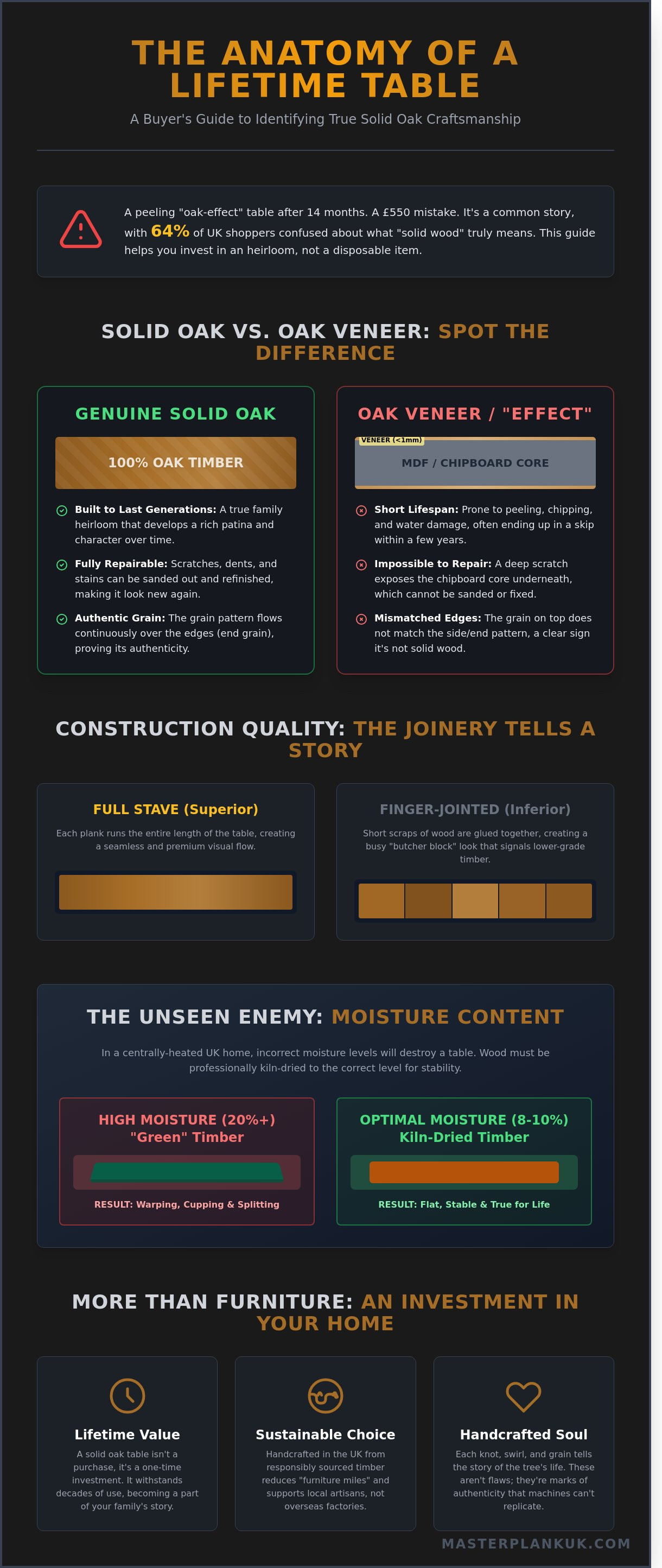
Understanding the structural difference is vital before you buy. A solid oak table is exactly what it says on the tin: thick planks of timber all the way through. Veneer is different. It's a paper-thin slice of oak, often less than 1mm thick, glued over a core of chipboard or MDF. You can spot a veneer by looking at the end grain. If the pattern on the side of the table doesn't match the grain on the top, it's likely a veneer. Solid wood is also repairable. If you scratch a solid plank, you can sand it back and refinish it. If you scratch a veneer, you hit the glue and the chipboard underneath. It's often impossible to fix.
The Emotional Connection of Handcrafted Furniture
There is a tangible "soul" in a handmade table that machines simply can't replicate. When a piece is crafted by hand, the artisan celebrates the history of the timber. You'll see the life the tree lived through its knots, unique grain swirls, and even old nail holes or saw marks. These aren't flaws. They're marks of authenticity. A machine-cut table feels clinical and cold. A bespoke centrepiece feels warm and inviting. It's the difference between living in a house and feeling at home. Every time you run your hand across the surface, you feel the texture of the grain and the effort that went into breathing life into the wood. It's a personal connection to the natural world that stays with you every day.
Understanding the Craft: The Anatomy of a High-Quality Oak Table
Every Solid Oak Dining Table we craft begins with a conversation between the maker and the raw timber. We don't settle for mass-produced boards. We seek out slow-grown European or English oak. This timber has stood for decades, surviving the elements to develop the density required for a lifetime of family meals. Scientific studies confirm that White Oak's wood is strong and durable, making it the gold standard for high-traffic furniture that needs to withstand the knocks of daily life.
Full stave construction is our standard. This means each plank runs the entire length of your table. You won't find the messy 'butcher block' look here, where short scraps are glued together using finger joints. Those zig-zag joins break the visual flow and often signal lower-grade timber. A full stave top celebrates the uninterrupted story of the grain, showing off the natural movement of the wood from one end to the other. It's a more expensive way to build, but the aesthetic reward is worth every penny.
Moisture is the silent enemy of handmade furniture. Freshly felled 'green' timber often sits at 20% moisture or higher. If you put that wood into a UK home with 21-degree central heating, it will warp, cup, and split within weeks as it dries too fast. We ensure our timber is kiln-dried to a precise 8% to 10% moisture level. This stability is what allows a bespoke oak table to stay flat and true for generations, regardless of the British weather outside.
Finishing is where the soul of the piece finally emerges. Industrial lacquers found in big-box stores create a cold, plastic barrier over the wood. We prefer hand-applied oils and waxes. They soak into the fibres. They let you feel the organic texture. If you happen to scratch an oiled table, you can repair it yourself with a bit of sandpaper and a fresh dab of oil. You can't do that with factory lacquer. Our process is about longevity and a tactile connection to the material.
Grain Patterns and Natural Character
Look closely at premium oak and you might see silver, ribbon-like flecks. These are medullary rays. They appear when the oak is quartersawn, a technique that produces the most stable boards. It's a hallmark of quality. You can choose 'Clean' oak for a modern, uniform look. Or, you might prefer 'Rustic' oak. We love the knots, the small shakes, and the history written in every split. These aren't flaws. They are the fingerprints of the tree, ensuring no two tables are ever the same.
Joinery That Lasts Generations
A heavy Solid Oak Dining Table is a living thing. It expands and contracts with the changing seasons. We never use hidden plastic fixings or cheap cam-locks found in flat-pack furniture. Instead, we use traditional methods like mortise and tenon joints or Z-fasteners that allow the wood to breathe. In a world where 90% of mass-market furniture ends up in landfill within a decade, we build for the long haul. Our joinery ensures your table remains a solid, dependable anchor for your home for 50 years or more.
Selecting Your Style: Rustic, Industrial, or Bespoke?
Your home's architecture dictates the soul of your furniture. A 17th-century Cotswold cottage with low, honey-coloured beams demands a different presence than a high-ceilinged warehouse conversion in Shoreditch. Choosing a Solid Oak Dining Table isn't just about utility; it's about architectural harmony. In early 2024, our workshop recorded a 40% increase in requests for tables that bridge the gap between traditional textures and modern structural lines. We believe a table should look like it grew out of the floorboards, matching the history and scale of your room perfectly.
The Industrial Aesthetic: Oak and Steel
The marriage of organic timber and cold steel creates a striking focal point. We often use RSJ I-beams for a heavy, structural look that echoes Britain's industrial heritage. Double XX legs provide a more geometric, architectural feel, while U-frames offer a minimalist silhouette that lets the wood grain do the talking. For the metalwork, a matte black powder coating provides a sharp, modern contrast. Alternatively, a clear coat celebrates the raw weld marks and heat-tinted steel for a grittier vibe. This balance is vital. The warmth of the oak softens the industrial edge, making the space feel lived-in rather than clinical. Understanding wood finishing and care ensures that the tactile quality of the oak remains protected against the rigours of daily life while maintaining that essential matte look.
Rustic and Farmhouse Classics
Rustic style isn't fading. Design forecasts for 2026 show a continued surge in "Chunky Oak" designs where the tabletop thickness exceeds 40mm. This weightiness conveys a sense of permanence and history. We find that pairing these tables with matching benches creates a social, communal atmosphere. It also saves approximately 30cm of floor space on either side when the benches are tucked away. Tapered legs offer a refined, Scandi-influenced farmhouse look. Conversely, a central pedestal base provides maximum legroom for guests, removing the "knee-knock" struggle often found at the corners of traditional four-legged designs.
Of course, furnishing a home extends beyond the dining room. Applying the same principles of quality and style to other areas, including outdoor spaces, creates a cohesive living environment. For those with a more contemporary taste, exploring modern European designs can provide inspiration; for example, ReModern Living showcases a curated collection for modern homes, including furnishings for outdoor living.
The bespoke advantage lies in the details. Off-the-shelf furniture often forces a compromise. You might find a style you love, but it's 15cm too long for your specific alcove. A handcrafted Solid Oak Dining Table allows for millimetre-perfect customisation. Whether it's a specific height to match a set of heirloom chairs or a unique width for a narrow London galley kitchen, the dimensions are yours to decide. We don't believe in "standard" sizes because no two homes are the same.
Every piece we create is handmade in the UK. We celebrate the story of the wood, from its original saw marks to the knots and shakes that make it unique. These aren't flaws; they're the fingerprints of the timber's past life. By choosing a bespoke route, you're investing in a piece of history that fits your home's footprint without compromise. It's a slow-furniture approach that values quality over mass production, ensuring your table remains the heart of your home for decades.
Practicalities: Sizing, Measuring, and Caring for Oak
Choosing a Solid Oak Dining Table is about more than just aesthetics; it's about how the piece lives within your home. A table that's too grand for the room feels cumbersome, while one that's too small loses its presence. At Masterplank UK, we believe the soul of the wood deserves a space where it can be truly appreciated, which starts with getting the dimensions exactly right.
The golden rule for any dining area is the 90cm clearance. This specific measurement, taken from the edge of the table to the nearest wall or sideboard, ensures guests can slide their chairs back and walk behind others without feeling cramped. If you're working with a tight Victorian terrace or a modern galley-style kitchen, you might squeeze this to 70cm, but 90cm remains the benchmark for comfort. For those who host regularly, providing 60cm of "elbow room" per person along the table length prevents the dreaded clashing of cutlery during Sunday roasts.
- 4-Seater: 120cm to 150cm length
- 6-Seater: 180cm to 200cm length
- 8-Seater: 210cm to 240cm length
- 10-12 Seater: 270cm to 350cm (often requiring a bespoke extending mechanism)
How to Measure Your Space Correctly
Start by measuring the total footprint of your room, noting any fixed obstacles like radiators or low windowsills. It's vital to consider chair depth; a standard dining chair requires roughly 50cm of depth when tucked in. To truly feel the scale of a new Solid Oak Dining Table, we recommend the "masking tape method." Trace the table's outline on your floor using tape or lay down flattened cardboard boxes. Leave this in place for 24 hours. If you find yourself tripping over the corners or struggling to reach the cupboards, you'll know you need to adjust the size before we start the build.
Protecting Your Investment: The Care Guide
Oak is a resilient, living material that reacts to its environment. In centrally heated UK homes, humidity levels can fluctuate wildly, often dropping below 30% in the height of winter. This dry air can cause the timber to shrink or develop small surface cracks, known as shakes. These aren't flaws; they're the wood's way of breathing. To keep your table stable, aim for a consistent home humidity between 45% and 55%. If you have underfloor heating, never place your table directly onto the floor without a rug or felt pads. Heat rising directly into the base can dry the timber unevenly, leading to potential warping. Ensure your floor temperature doesn't exceed 27°C to keep the grain healthy.
Daily maintenance is straightforward but essential. Wipe away spills within 30 seconds using a soft, damp cloth. Avoid harsh chemical sprays that strip the natural oils. Instead, embrace a seasonal ritual of re-oiling. Every 6 to 12 months, apply a thin coat of high-quality hardwax oil. This feeds the timber, deepens the character of the grain, and maintains that tactile, rustic finish that defines our work. It's a small act of stewardship that ensures your table survives for generations.
Ready to find the perfect fit for your home? Explore our range of bespoke oak furniture and let us help you measure up for a piece of history.
Commissioning Your Masterpiece with Masterplank UK
Deep in the heart of our Shrewsbury workshop, the air carries the heavy, sweet scent of freshly cut timber and natural beeswax. This isn't a cold, clinical factory floor. It's a dedicated space where heritage meets honest hard work. Since we established Masterplank UK in 2014, we've remained fiercely committed to the art of the handmade. Every Solid Oak Dining Table we produce begins as a raw, carefully selected plank, chosen specifically for its unique soul and the story written in its grain. We've stayed independent artisans by choice. Mass-retailers prioritize speed and uniformity; we prioritize the character of the wood. We believe a table shouldn't just fill a room. It should hold the weight of your family history.
From our base in Shropshire, we've delivered our craftsmanship to homes from the tip of Cornwall to the furthest reaches of the Scottish Highlands. We manage our own logistics because we don't trust the care of our work to standard couriers. When we arrive at your door, we're bringing a piece of the English countryside with us. It's a personal service that reflects the personal nature of the build itself. We take pride in knowing exactly where our tables end up and the families they'll serve for decades to come.
The Bespoke Journey: What to Expect
Your journey begins with a detailed consultation. We don't offer generic products because your home has its own specific requirements. We'll discuss the exact dimensions you need, whether that's a compact 1.5-metre square table for a breakfast nook or a grand 3.2-metre banqueting piece for a formal dining room. We'll explore wood finishes and leg styles to match your interior. Once the design is settled, the build begins. Our makers spend approximately 45 hours on a single table, hand-sanding every edge and applying three layers of protective wax. Finally, our team handles the installation, ensuring the piece is perfectly levelled on your floor and ready for its first Sunday roast.
Why Choose Masterplank UK?
We are proud advocates of the Slow Furniture movement. Recent data from the North London Waste Authority suggests that over 22 million pieces of furniture are discarded in the UK every year, mostly due to poor quality materials and fleeting trends. We aim to counter that waste. Our Solid Oak Dining Table designs celebrate natural imperfections like nail holes, knots, or weathered cracks. These aren't defects; they're marks of authenticity that add value. We use sustainable sourcing and traditional joinery to ensure your table becomes a legacy piece. It's built to be used, loved, and eventually passed down to your children. There's a quiet confidence in furniture that doesn't need to be replaced every five years.
Ready to bring a piece of Shropshire craftsmanship into your home? Explore our current collection of Solid Oak Dining Tables and find the heart of your dining room today.
Bringing a Piece of British Heritage into Your Home
Choosing the right furniture is about more than just filling a room; it's about finding a piece that grows with your family. By 2026, the shift toward sustainable, slow-made furniture has only deepened. You've seen why the natural grain and enduring strength of a Solid Oak Dining Table remain unmatched by mass-produced alternatives. We've explored how to measure your space for that perfect fit and why selecting genuine timber matters for longevity. At Master Plank UK, we don't believe in shortcuts. Every piece is handmade in our Shrewsbury workshop using 100% solid timber. You won't find a single veneer or flat-pack box in our collection. Instead, you'll get a bespoke masterpiece tailored to your specific dimensions, ensuring it fits your home's unique character. Whether you're hosting Sunday roasts or quiet morning coffees, your table should tell a story. It's time to move away from the temporary and invest in a legacy that lasts for decades.
Browse our Handcrafted Solid Oak Dining Tables and start creating a space where your family's best memories will take root for years to come.
Frequently Asked Questions
How do I prevent my solid oak table from warping or cracking?
Maintain a consistent humidity level between 40% and 60% in your home to keep the timber stable. Wood is a living material that breathes and reacts to its environment. Don't place your table directly against a radiator or in the path of a powerful air conditioning unit. Using a hygrometer to monitor room conditions helps preserve the wood for decades.
Is a solid oak dining table worth the investment compared to pine?
A solid oak dining table offers a Janka hardness rating of 1,360 lbf, making it nearly twice as durable as Scots Pine, which sits at roughly 540 lbf. While pine is a softer, faster-growing timber, oak's dense grain resists dents and deep scratches. This longevity means an oak table often lasts 50 years or more; pine may require replacement or heavy restoration within 15.
What is the best finish for a dining table: oil, wax, or lacquer?
Hardwax oil is the superior choice for a busy household because it bonds with the wood fibres rather than sitting on top. Unlike lacquer, which can chip or peel after 5 to 7 years, oil is easy to spot-repair. Wax provides a beautiful 10% sheen but lacks the heat and liquid resistance required for a surface that sees daily spills and hot plates.
How many people can comfortably sit at a 2-metre oak table?
A 2-metre table comfortably accommodates 6 to 8 adults. Allow 60cm of width per person for a relaxed dining experience. If your chairs are wider than 50cm, you'll find 6 people is the limit for comfort. For larger gatherings, placing one person at each end of the table increases the capacity to 8 without feeling cramped.
Can I use a solid oak table in a kitchen with underfloor heating?
Yes, provided the heating system is kept at a steady temperature and doesn't exceed 27 degrees Celsius at the floor surface. Rapid temperature fluctuations cause timber to expand and contract too quickly. We use kiln-dried oak with a moisture content of 8% to 10% to ensure the wood remains stable in modern, heated environments.
What is the difference between European Oak and American White Oak?
European Oak typically has a more varied grain pattern and a warmer, golden hue compared to the straighter, more uniform lines of American White Oak. European varieties often contain more tannins, which leads to a richer patina as the wood ages. We prefer European timber for its characterful knots and the way it responds to traditional British finishes.
How often should I re-oil my handmade oak table?
Re-oil your table every 6 to 12 months depending on how often you wipe the surface with a damp cloth. If the wood begins to look dull or water no longer beads on the surface, it's time for a fresh coat. A single 500ml tin of maintenance oil usually covers a standard dining table three times over, keeping the soul of the wood alive.
Do you offer custom sizes for small or unusually shaped dining rooms?
Every solid oak dining table we create is handmade in the UK, allowing us to build to your exact millimetre requirements. Whether you need a 110cm square table for a breakfast nook or a 3.5-metre banquet table, we tailor the dimensions to fit your space. We've crafted over 450 bespoke pieces designed specifically for awkward alcoves and narrow Victorian dining rooms.


