


A dining table shouldn't be a temporary fixture that ends up in a landfill after five years of family life. You want a piece that tells a story, yet it's natural to worry that "rustic" might mean a surface that warps or cracks the moment your central heating kicks in this winter. We understand that hesitation. You're looking for a Rustic Dining Table that offers more than just a weathered look; you need a centrepiece that survives the chaos of Sunday roasts and the dry air of a modern British home.
In this guide, we'll show you how to select a table that marries soulful character with lifelong durability. We'll clarify the 2026 standards for reclaimed versus new timber and explain why our specific kiln-drying process, which brings moisture levels down to a stable 10%, prevents the structural issues often found in mass-produced furniture. From choosing bespoke dimensions for those tricky alcoves to mastering simple maintenance, you'll gain the confidence to invest in a piece that's proudly handmade in the UK and built to last for generations.
Key Takeaways
- Learn how to identify authentic craftsmanship by celebrating the natural knots and weathered textures that give timber its unique soul.
- Discover how to choose the perfect Rustic Dining Table by balancing rugged industrial aesthetics with the refined charm of modern farmhouse design.
- Compare the enduring prestige of solid oak against the warm, tactile appeal of chunky pine to find the right timber for your lifestyle.
- Master the essential "Golden Rule" of spatial planning to ensure your dining room remains functional and comfortable for every guest.
- Understand why bespoke furniture handmade in the UK provides a sustainable, high-quality alternative to the environmental cost of mass-produced imports.
What Defines a Truly Rustic Dining Table?
A Rustic Dining Table isn't just a piece of furniture; it's a living piece of history for your home. At its core, this style celebrates the raw honesty of the material. We look for the knots, the swirling grain patterns, and the natural splits that mass-production factories would discard. These aren't flaws. They are the fingerprints of the tree, telling a story that spans decades or even centuries.
In 2026, the British home continues to move away from the sterile, flat-pack aesthetic. People want texture. However, rustic doesn't mean splintery or unrefined. The true art lies in the balance between rugged character and a touchable, smooth finish. We sand our surfaces with precision, ensuring the wood feels soft under your hand while retaining every ounce of its visual history. It's about creating a piece that's durable enough for a busy family Sunday roast but elegant enough for a formal evening.
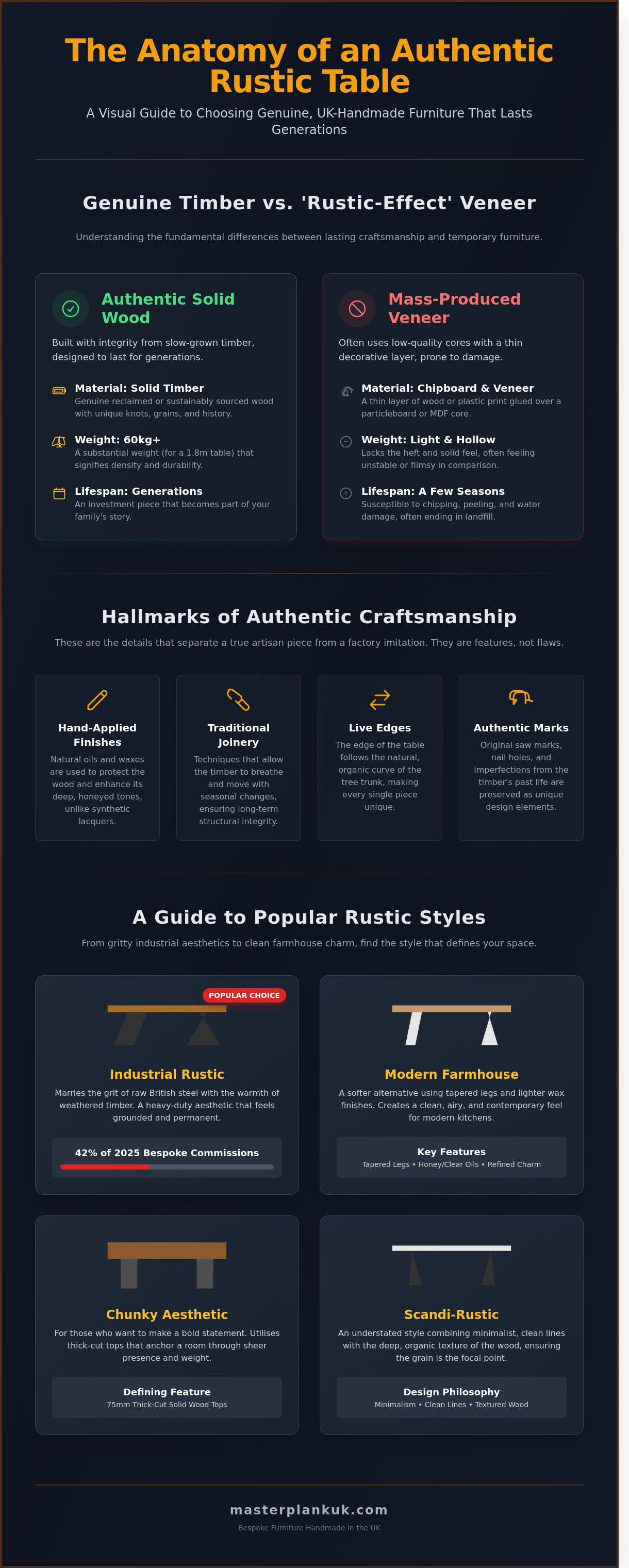
There's a massive difference between genuine timber and the 'rustic-effect' veneers found in high-street chains. Those mass-produced items often use thin layers of wood or even printed plastic over chipboard. They lack the weight, the smell, and the longevity of solid wood. A real table often weighs upwards of 60kg for a standard 1.8m piece, and it's built to last for generations rather than a few seasons. When you run your hand across a Master Plank surface, you're feeling the density of slow-grown timber, not a hollow imitation.
The Soul of the Wood: Reclaimed vs. Sustainably Sourced
Reclaimed timber carries a unique weight of history. We source salvaged beams from 19th-century Victorian warehouses and floorboards from old British mills. If we use new wood, it must be sustainably sourced and kiln-dried to a moisture content of 8% to 10%. This specific drying process is vital for home stability, preventing the wood from warping when you turn the central heating on in October. We hand-select every board to ensure the grain tells a story.
Key Features to Look For
Authentic craftsmanship is visible in the details. A quality build shows through the way the timber is treated and joined. We focus on features that highlight the wood's journey:
- Live Edges: These follow the natural curve of the tree trunk, making every table a one-off shape.
- Traditional Joinery: We use techniques that allow the wood to breathe and move naturally with the seasons.
- Hand-Applied Finishes: We prefer natural oils and waxes over synthetic lacquers. These soak into the grain, protecting it from spills while enhancing the deep, honeyed tones of the wood.
- Authentic Marks: Original nail holes and saw marks from the mill are kept as design features, proving the timber's past life.
Choosing a handmade piece means you're investing in the slow-furniture movement. It's a commitment to sustainability and British manufacturing that keeps traditional skills alive in our local workshops.
Comparing Popular Rustic Styles: From Industrial to Farmhouse
Every piece of wood tells a story. A Rustic Dining Table isn't just a functional surface; it's a piece of history brought into the modern home. In 2025, approximately 42% of our bespoke commissions focused on the Industrial Rustic look. This style marries the grit of raw, British steel with the warmth of weathered timber. It's a heavy-duty aesthetic that celebrates the contrast between cold metal and the organic texture of reclaimed planks, complete with original nail holes and saw marks. These tables feel grounded and permanent.
The Modern Farmhouse style offers a softer alternative. We often use tapered legs and lighter wax finishes, such as honey or clear oils, to create a contemporary feel. It's less about the ruggedness of the workshop and more about a clean, airy kitchen environment. For those who want to make a bold statement, the 'Chunky' aesthetic remains a firm favourite. These designs utilise 75mm thick-cut tops that anchor a room through sheer presence. If you prefer something more understated, Scandi-Rustic combines minimalist, clean lines with deeply textured wood, ensuring the natural grain remains the focal point without overwhelming the space.
Industrial Frame Options
The base of your table dictates the room's energy. Trapeze and trapezium legs offer a geometric, architectural feel that works well in open-plan living areas. For maximum stability, box frames made from 50mm x 50mm steel sections provide a heavy-duty look that's built to last for generations. If you're looking for a mid-century twist, hairpin legs add a delicate touch to a heavy Rustic Dining Table top, creating a sense of weightlessness that suits smaller dining nooks. Each frame is handmade in the UK to ensure it supports the substantial weight of our reclaimed timber.
Traditional and Pedestal Designs
The classic farmhouse four-leg design remains a timeless choice for period properties and barn conversions. We typically use 90mm square legs to provide a sturdy, dependable silhouette. Pedestal bases are the ideal solution for round tables or tighter spaces, as they maximise legroom by removing corner obstructions. When choosing, consider your home's architecture. A Victorian terrace might suit the elegance of a turned pedestal; a modern extension often calls for the sharp lines of a cross-frame. You can explore our range of handmade frames to find the perfect match for your interior's soul.
Choosing the Right Timber: Solid Oak vs. Chunky Pine
Selecting the timber for your Rustic Dining Table is the most vital step in our bespoke process. It's a choice between two distinct personalities, each bringing its own history and texture into your home. We see oak as the enduring patriarch of the dining room, while pine acts as the warm, adaptable heart of the house. Your choice depends on whether you value the indestructible nature of a hardwood or the evolving, lived-in character of a heritage softwood. Both materials are handmade in the UK, ensuring that the soul of the wood is preserved in every joint and surface.
The visual difference lies in the story told by the grain. Oak features a tight, intricate pattern, often displaying beautiful medullary rays that shimmer under a natural wax finish. Pine is bolder. It celebrates large, dark knots and wide, sweeping grain lines that provide that classic farmhouse aesthetic. While oak is a 100-year investment piece, pine offers a more accessible entry point into high-quality furniture without sacrificing the "chunky" feel our customers love. Your Rustic Dining Table should be a reflection of your lifestyle, whether that involves a pristine showpiece or a table that wears the marks of a busy family life with pride.
Solid Oak: The Hardwood Choice
Oak is the gold standard for a reason. With a density of roughly 750kg per cubic metre, it's incredibly difficult to dent or scratch. This makes it the perfect surface for a busy UK household where the table serves as a desk, a craft station, and a dinner setting. It's a timber that demands respect and offers prestige in return. It takes to stains beautifully, whether you prefer a light, "raw" look or a deep, Tudor-inspired dark finish. For more detail, see our Definitive Guide to Solid Oak Dining Tables.
Rustic Pine: Character and Versatility
Don't mistake pine's lower price point for lower quality. Our chunky pine is selected for its soul and its ability to develop a rich, honeyed patina over time. Because pine is a softer timber, it records the history of your family; it picks up small marks and "character" over the years that only add to its rustic charm. It's also significantly lighter than oak, which is a practical benefit if you like to rearrange your living space for guests. You can also explore the charm of a Chunky Pine Coffee Table to see how this timber ages gracefully in a smaller format.
Sizing and Practicalities: How to Organise Your Dining Space
A handcrafted Rustic Dining Table serves as the heart of the home, but its beauty must be matched by its utility. To create a room that feels effortless rather than cramped, follow the golden rule of spatial design: leave 90cm of clearance between the table edge and your walls. This specific distance ensures guests can slide their chairs back and walk behind others without a struggle. It transforms a tight squeeze into a flowing, social environment.
Seating capacity depends on both length and the width of your chosen chairs. For a comfortable experience, allow 60cm of tabletop width per person. A 150cm table typically accommodates 4 to 6 people, while a 210cm length is better suited for 8. If you frequently host large Sunday roasts but value your floor space during the week, an extending table offers the perfect compromise. These bespoke designs provide extra room for guests while maintaining a compact footprint for daily life.
- Benches: These are a staple of the rustic aesthetic. They tuck completely under the table when not in use, saving roughly 30cm of floor depth compared to chairs.
- Chairs: Mixing traditional seating with a bench on one side creates a relaxed, gathered feel. It breaks up the visual weight of the timber.
- End Seating: Ensure your table is at least 90cm wide if you plan to seat people at the ends to avoid clashing plates.
Measuring for Your Bespoke Table
Visualising a piece of furniture in an empty room is difficult. Use masking tape to floor-plan the exact dimensions before you order. Tape out a 180cm by 90cm rectangle on your floor and leave it there for a day. Walk around it. Open nearby cupboards. This simple 10-minute task prevents costly mistakes. Standard table height sits at 76cm, which provides the best ergonomic support for the average adult. Pay close attention to leg placement. Corner legs maximise legroom, while inset trestle designs allow for more flexible seating along the sides without the dreaded knee-clash against the frame.
Caring for Wood in Centrally Heated Homes
Reclaimed timber is a living material. It breathes. In many UK homes, central heating can cause humidity levels to drop below 45% during the cold months of December and January. This dry air can lead to slight movement or small shakes in the wood. It is not a flaw; it is the story of the timber reacting to its environment. To keep your table in peak condition, try to keep it away from direct contact with radiators. A simple cleaning routine involves a lint-free damp cloth followed by a buff with a natural wax every 6 to 12 months. This preserves the weathered character and protects the grain from spills.
Ready to find the perfect fit for your home? Explore our range of bespoke rustic dining tables and discover a piece built to last a lifetime.
The Masterplank Difference: Why Bespoke Craftsmanship Wins
Choosing a Masterplank creation means you're opting out of the disposable culture that defines much of the modern furniture market. While roughly 78% of furniture sold in the UK is now imported from mass-production hubs, we choose a different path. Every Rustic Dining Table we create is handmade right here in our UK workshop. This approach eliminates the massive carbon footprint associated with trans-oceanic shipping and ensures your investment supports local craft. We don't believe in the "flat-pack" philosophy. Those pieces are designed to be temporary; ours are built to last generations. By avoiding flimsy cam-locks and thin veneers, we ensure your table remains a solid, dependable anchor for your home.
The bespoke process is where your vision takes shape. We don't force you to choose from a limited catalogue of three sizes. We tailor the dimensions to your specific room. Whether you need a narrow 85cm width for a cosy breakfast nook or a grand 3-metre length for large family gatherings, we make it happen. You control the finish too. From light, airy waxes to deep, weathered tones, we match the timber to your interior palette. This isn't just about furniture; it's about creating a piece that fits your life perfectly.
Every piece of timber we use carries a badge of honour. It isn't just wood; it's a story. We celebrate the natural imperfections that mass manufacturers try to hide. Original nail holes, weathered saw marks, and historic cracks are preserved as marks of authenticity. These features aren't flaws. They're the soul of the wood, proving its history and giving your table a character that can't be replicated by a machine.
Supporting Artisanal British Manufacturing
Our workshop is a hub of traditional woodworking where we prioritise quality over speed. We use hand-finishing techniques that often take four times longer than industrial spraying methods. This slow-furniture approach ensures every Rustic Dining Table receives the attention it deserves. We offer complete transparency in our sourcing, so you know exactly where your timber originated. By choosing Masterplank, you're directly supporting the survival of heritage skills in Britain and investing in a sustainable future.
Your Journey to a Forever Table
We want you to be completely confident before we pick up a saw. This is why we recommend ordering samples first. Seeing how the grain and colour react to the specific light in your dining room is a vital step. Once you've seen the quality, our consultation process helps refine the final design. We'll discuss leg styles and edge profiles to ensure the finished product is exactly what you imagined. Browse our Rustic Table Collection and start your bespoke journey today.
Bring the Heart of the Workshop into Your Home
Your dining room is the stage for a lifetime of shared stories. Choosing a handcrafted centrepiece isn't just about filling a gap in the floor plan; it's about finding a legacy piece that grows more beautiful with every year. We've explored how the choice between solid oak and chunky pine defines your home's atmosphere. We've looked at why measuring your space to the nearest millimetre ensures a perfect fit. By 2026, the shift towards the slow-furniture movement has shown that homeowners truly value the honesty of reclaimed timber. They want history, not mass production.
At Masterplank UK, every piece is handmade in our workshop by artisans who respect the soul of the wood. Since 2014, we've used 100% reclaimed or sustainably sourced solid timber. Weathered grain. Historic nail holes. Saw marks that tell a story. We celebrate these as marks of character, not flaws. We don't do clinical perfection. Because we offer bespoke sizing on every design, you'll get a table that fits your life exactly. Design your perfect Rustic Dining Table with Masterplank UK today. We're ready to help you create a space where memories are made.
Frequently Asked Questions
What is the best wood for a rustic dining table?
The best wood for a rustic dining table depends on your lifestyle, but reclaimed pine and European Oak are our top choices for durability and character. Reclaimed timber offers a unique soul, often salvaged from 19th-century buildings, while Oak provides a 100-year lifespan of strength. Each plank carries its own story through nail holes and saw marks. We find that 70% of our customers choose reclaimed wood for its environmental benefits and weathered texture.
How do I stop my solid wood table from warping in a heated home?
You can prevent warping by maintaining a consistent indoor humidity level between 40% and 60% throughout the year. Wood is a living material that breathes. Placing your table at least 2 metres away from direct heat sources like radiators or wood burners is essential for stability. Our kiln-drying process reduces moisture content to 8-10% before crafting, which significantly lowers the risk of movement in modern UK homes.
Can I use a rustic dining table in a modern kitchen?
A rustic dining table creates a stunning focal point in a modern kitchen by introducing warmth and organic textures to a minimalist space. The contrast between sleek cabinetry and 40mm thick characterful timber is a timeless design choice. In 2025, approximately 65% of our bespoke commissions were designed for contemporary homes. It softens the hard lines of a modern kitchen, making the room feel more inviting and lived-in.
How do I clean and maintain a rustic wax finish?
Cleaning a rustic wax finish requires nothing more than a soft, damp cloth and a drop of mild, pH-neutral soap. You should avoid harsh chemicals or bleach, as these strip the protective layer and dull the grain. If a spill occurs, wipe it away within 5 minutes to prevent staining. To keep the timber looking its best, apply a fresh coat of clear furniture wax every 6 months to maintain the deep, tactile lustre.
What is the difference between reclaimed wood and rustic wood?
Reclaimed wood is timber salvaged from old structures like Victorian warehouses or 1920s barns, while rustic describes an aesthetic style that celebrates natural imperfections. Not all rustic furniture is made from reclaimed materials, but all reclaimed wood is naturally rustic. Our reclaimed planks often feature original bolt holes and scars from their previous lives. This history gives each piece a soul that mass-produced timber simply cannot replicate.
How long does a handmade rustic dining table take to be delivered?
Our current lead time for a bespoke, handmade rustic dining table is 6 weeks from the date of your order. This allows our artisans enough time to carefully select the timber, treat the wood, and apply the hand-finished wax. We don't believe in rushing the process. Each table is crafted individually in our UK workshop, ensuring it meets our quality standards before being delivered via our specialist 2-man furniture courier service.
Is a rustic dining table suitable for families with young children?
Rustic tables are exceptionally family-friendly because their natural textures and existing marks hide the inevitable wear and tear of family life. A small scratch or a pen mark often blends into the grain rather than ruining the piece. Unlike high-gloss furniture, these tables thrive on being used every day. If a significant dent occurs, you can often repair it with a bit of wax and a 10-minute buffing session at home.
Do I need to re-oil or re-wax my table regularly?
You should re-wax your table every 6 to 12 months to preserve the wood's hydration and protective barrier. It's a simple 15-minute task that ensures the timber doesn't dry out or lose its rich colour over time. We recommend using a high-quality beeswax or Fiddes Supreme Wax Polish for the best results. Regular maintenance like this protects the surface from water rings and keeps the character of the grain vibrant for decades.


