


That glossy, neon-blue river might look striking on a screen, but the trend for resin tables is beginning to show its age far faster than the ancient timber it encases. It's perfectly natural to want a showstopper for your home, something that feels personal and handcrafted. However, many homeowners are now finding that the 2019 craze for epoxy comes with hidden costs, from persistent chemical smells to scratches that are nearly impossible to buff out at home. You deserve a piece of furniture that feels as good as it looks, without the worry of it becoming a dated plastic relic in five years.
In this craftsman’s guide, we’ll reveal the truth about how these materials age and why traditional solid timber remains the superior choice for a sustainable, healthy home. We'll compare the environmental impact of synthetic pours against reclaimed British wood and explain why a £2,000 investment should grow in character rather than lose its lustre. From repair tips to the soul of the grain, we're exploring why the slow-furniture movement is the only way to ensure your dining table tells a story worth keeping.
Key Takeaways
- Understand why the "indestructible" promise of plastic often fails under British central heating compared to the natural resilience of solid timber.
- Weigh the environmental cost of petrochemicals against the sustainable, low-VOC benefits of breathing new life into reclaimed UK wood.
- Compare the simple joy of maintaining a waxed timber surface with the complex and often permanent challenges of repairing damaged resin tables.
- Discover how to celebrate natural imperfections like saw marks and knots to achieve a timeless statement look without the need for synthetic chemicals.
What are Resin Tables and Why are They Trending?
Step into any high-end furniture showroom or scroll through your Pinterest feed, and you will likely encounter the striking aesthetic of resin tables. Often called "river tables," these pieces feature two slabs of natural timber joined by a thick, flowing channel of synthetic epoxy. This design choice attempts to bridge the gap between the raw, rugged beauty of the forest and a sleek, modern finish. Since roughly 2011, when the concept first gained traction through artists like Greg Klassen, the trend has exploded across the UK. By 2018, Google search interest for these pieces had surged by over 400 percent, fuelled by a growing DIY maker movement and the viral nature of woodworking videos on social media.
The Anatomy of an Epoxy River Table
The core of this design relies on "live edge" timber. These are slabs where the natural, bark-covered edge of the tree is kept intact rather than being squared off by a saw. Makers place two of these edges facing inward, creating a void that resembles a winding river. This gap is then filled with liquid epoxy resin, a chemical compound consisting of a resin and a hardener. Once mixed, a chemical reaction occurs that causes the liquid to cure into a solid, durable plastic over 24 to 72 hours. While clear pours remain a staple, popular variations include pearlescent pigments, deep oceanic blues, and even glow-in-the-dark powders that turn a dining table into a vibrant light show.
The Appeal of the "Statement Piece"
There is no denying the immediate visual impact these tables provide. They've become the go-to centrepiece for industrial lofts and modern rustic homes because they offer a bold "wow factor" that traditional furniture sometimes lacks. However, this level of customisation can become a trap. A bright turquoise resin river might look stunning today, but interior trends move fast. At Master Plank UK, we see things differently. We believe the natural story of the timber, its weathered grain, and the history of its previous life should be the star of the show.
We focus on the wood itself, celebrating the unique character of reclaimed planks without masking them in layers of synthetic plastic. While the trend for resin tables continues to capture attention, our heart remains with the timeless, honest beauty of handmade wood furniture. We prefer the tactile feel of a grain that has survived decades of use. It's about a connection to the material that feels grounded and permanent, rather than a piece of furniture that relies on a fleeting aesthetic. Our commitment to British craftsmanship means we value the soul behind every knot and nail hole, ensuring your furniture remains a classic part of your home for generations.
The Craftsman’s Critique: Durability and Ageing
While resin tables are often marketed as indestructible, they lack the quiet resilience of natural timber. The core issue lies in the marriage of two opposing materials. Timber is organic; it breathes, expands, and contracts with the seasons. Resin is essentially a rigid block of plastic. In our workshop, we see the life in every plank and understand that wood doesn't stop moving just because it has been planed and sanded. When your central heating kicks in during a cold British November, the moisture levels in your home drop. The wood tries to move, but the resin refuses to budge. This tension often leads to delamination, where the resin pulls away from the wood, or causes the timber to split under the pressure.
Choosing a solid oak dining table ensures your furniture works with nature rather than against it. Oak has survived for centuries in various climates because its cellular structure allows for this seasonal shift. We build our pieces using traditional techniques that accommodate this movement, ensuring the structural integrity remains sound for decades. It is about building for a lifetime, not just for a temporary aesthetic trend. By forcing timber to bond with a synthetic substance, you create a structural conflict that often ends in heartbreak for the owner once the seasons begin to change.
The Yellowing Effect and UV Sensitivity
Ultra-violet light triggers a photochemical reaction in epoxy polymers that breaks down their molecular bonds over a 5 to 10 year period. Even the most expensive "UV-resistant" resins eventually lose their crystal-clear finish because these chemical additives only delay the inevitable reaction rather than stopping it. What starts as a transparent river slowly turns a murky, amber hue. This is a stark contrast to the beautiful natural patina of aged oak. While timber grows more distinguished and deeper in character with time, yellowing resin simply looks like ageing plastic. It is a permanent degradation that no amount of surface polishing can truly fix.
Surface Scratches and the "Plastic" Feel
Resin is a high-maintenance surface that betrays every sign of daily life. A single ceramic plate or a laptop dragged across a gloss finish leaves a permanent white micro-scratch. Over time, these marks accumulate into a cloudy haze that dulls the entire piece, making it look worn in all the wrong ways. Timber offers a different story. A scratch on a rustic oak table often blends into the grain or can be easily buffed out with a bit of wax and a cloth. There is also the matter of touch. Resin feels cold, sterile, and undeniably synthetic. Our bespoke reclaimed furniture retains the natural warmth of the wood, offering a tactile connection to the history of the timber that a synthetic pour can never replicate.
Sustainability: The Environmental Cost of Resin
Resin tables are often marketed as high-end art pieces, yet they carry a heavy environmental burden that is hard to ignore. At its core, epoxy resin is a liquid plastic derived from crude oil. It's a petrochemical product that doesn't belong to the natural world. Once the chemical reaction occurs and the resin hardens, it becomes a non-biodegradable solid. It won't break down in our lifetime, or the next. This creates a permanent waste problem for future generations. Beyond the material itself, the curing process releases Volatile Organic Compounds (VOCs) into your home. Research indicates that some epoxy resins can continue off-gassing for weeks after pouring, potentially affecting indoor air quality in modern, well-insulated UK homes.
Petrochemicals vs. Reclaimed Timber
The carbon footprint of a single piece of furniture tells a long story. Producing just one kilogram of liquid epoxy resin generates approximately 6.3 kilograms of CO2. When you consider the vast amounts of liquid plastic poured into larger resin tables, the numbers become staggering. We prefer a different narrative. Master Plank UK is built on the belief that we should protect the planet while we furnish our homes. We focus on carbon-sequestering materials. Solid wood actually stores carbon, keeping it out of the atmosphere for as long as the furniture exists. Our commitment involves breathing new life into old timber, turning salvaged boards into heirloom pieces like our handcrafted timber fireplace mantels. This approach respects the history of the wood and the health of the environment.
The "Buy Once, Buy Well" Philosophy
Many composite pieces are essentially "fast furniture" disguised with a premium price tag. The problem lies in their end-of-life options. Because resin is bonded to the wood at a molecular level, these tables are almost impossible to recycle. They cannot be separated back into clean timber and plastic. They are destined for the skip. Data from the North London Waste Authority suggests that UK households dispose of around 22 million pieces of furniture annually. We want to stop that cycle. A solid timber table follows a circular life. It's durable. It's honest. You can sand it down when it gets scratched. You can re-oil the grain to bring back its lustre. Weathered textures and rustic character only improve with age. Choosing solid wood means avoiding the landfill-bound trap of modern composites. It's an investment in a piece that lives and breathes with your home for decades, rather than a few seasons.
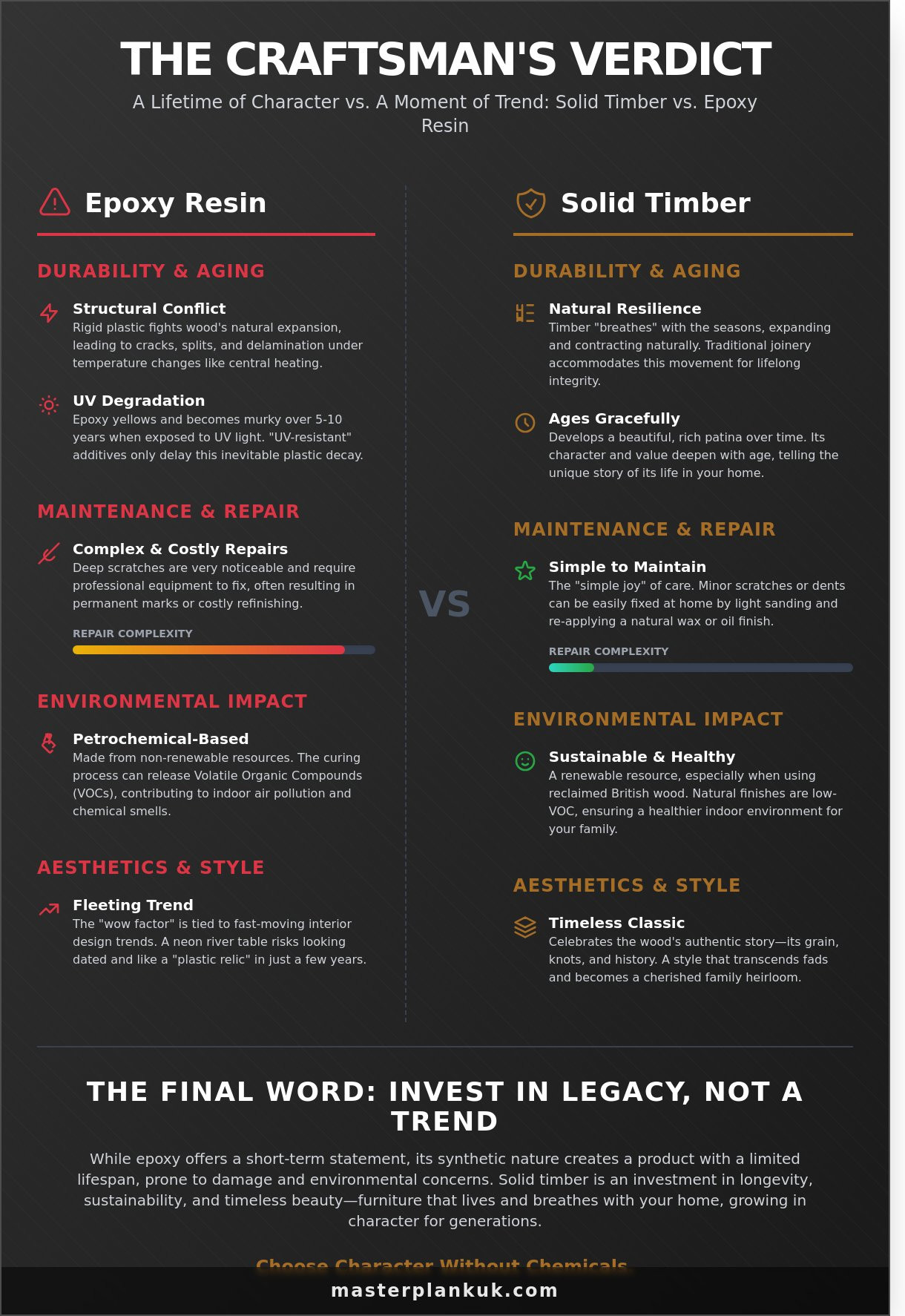
Practical Comparison: Maintenance and Repairability
Living with a piece of furniture shouldn't feel like walking on eggshells. Real life involves spilled red wine, hot mugs, and the occasional stray craft knife. When you choose a timber surface, you're investing in a material that understands how to age. In contrast, resin tables often demand a level of clinical care that feels out of place in a busy British home. While a resin surface looks striking under showroom lights, it's prone to micro-scratches that dull the finish over time. These marks can't be wiped away; they require professional buffing tools and abrasive compounds to rectify.
Sanding and Oiling: A Simple Ritual
Natural hardwax oils bond with the wood fibres to create a liquid-resistant shield that remains vapour-permeable, allowing the timber to expand and contract naturally with the seasons. This breathability is vital for the health of the wood. If you've chosen a bespoke walnut table, maintenance is a straightforward, tactile process. You don't need a workshop full of gear. A small tin of oil, a lint-free cloth, and a sheet of 150-grit sandpaper are all that's required to erase a ring mark or a shallow scratch. You can't do this with plastic. If a resin pour chips or cracks, the repair often involves damming the area and pouring fresh chemical compound, which rarely blends seamlessly with the original aged resin.
Long-term Style and Resale Value
Trends move fast. Data from interior search trends shows that "river tables" peaked in popularity between 2019 and 2021, and many now view them as a dated design choice. They're the lava lamps of the furniture world. Solid oak and reclaimed pine have remained staples of British design for centuries because they aren't tied to a specific decade. This timelessness reflects in the resale market. A 20-year-old solid timber table often retains 60% of its original value, whereas second-hand resin tables frequently struggle to find buyers as the plastic begins to yellow or show its age.
- 20-year cost of ownership: A timber table requires approximately £45 in oil and sandpaper over two decades.
- Professional restoration: Refinishing a damaged resin surface can cost upwards of £350 per visit.
- Ease of use: Timber can be spot-repaired in 20 minutes; resin requires a dust-free environment and 24-hour curing times.
We believe furniture should be a heritage piece, not a disposable item that ends up in a landfill because it couldn't be repaired. There's a quiet confidence in knowing your table can be brought back to life with nothing more than a bit of patience and a steady hand.
The Masterplank Alternative: Character Without Chemicals
We don't hide the story of our timber under a layer of plastic. While resin tables rely on synthetic fillers to create visual interest, we believe the wood itself provides all the drama needed. Every knot, every original saw mark from the mill, and every surface crack tells a story. These aren't defects. They are the fingerprints of nature. We choose to celebrate these features rather than mask them in epoxy.
Achieving a statement look requires patience and traditional skill. Our artisans spend between 40 and 60 hours on a single dining set, using hand-tools and time-honoured joinery to ensure the structural integrity of the piece. We focus on the tactile reality of the wood. You can feel the history in the grain. A dining table should feel like a living part of your home, not a sterile showroom piece. Choosing a Masterplank UK piece, 'Handmade in the UK', means you are supporting a local workshop that values the soul of the material over the speed of a chemical pour.
A striking table often needs a companion that shares its DNA. Many of our clients find that a bespoke wood bench provides the perfect balance. It offers a communal, rustic feel that chairs often struggle to replicate. These benches are crafted from the same character-rich timber, ensuring the grain patterns and textures flow seamlessly across your dining space.
Bespoke Design: Tailored to Your Home
Every home has its own rhythm. We help you choose timber species and grain patterns that reflect your specific aesthetic. Whether it is the golden warmth of English Oak or the rugged texture of reclaimed pine, the choice is yours. We use high-quality natural waxes and oils to highlight the wood’s "soul" without creating a plastic barrier. This approach ensures your furniture ages gracefully. It develops a patina over 20 or 30 years that no resin-heavy piece could ever mimic. You aren't just buying furniture; you are commissioning a piece of your own personal history.
Conclusion: Choosing a Legacy
The choice between timber and resin is a choice between a passing trend and a lasting legacy. We choose timber every time because it is honest, sustainable, and uniquely beautiful. We invite you to take a virtual tour of our workshop or speak with our craftsmen to see how we transform raw planks into heirloom pieces. Your home deserves the warmth of real wood and the dedication of British craftsmanship.
Ready to find your perfect centrepiece?
Explore Masterplank UK's collection of handcrafted solid oak tables and discover the beauty of authentic timber.
Invest in a Piece of British Heritage
Choosing between resin tables and solid timber comes down to the legacy you want to leave in your dining room. While synthetic resins offer a modern flash, they carry a heavy environmental price and often show their age through yellowing or surface cracks that are nearly impossible to repair at home. A handcrafted oak table offers a different path. By choosing reclaimed timber, you're opting for a material that has already stood the test of time for decades; sometimes even centuries. Our craftsmen focus on the slow-furniture movement, ensuring every piece is handmade in the UK to combat the 22 million pieces of furniture discarded annually across the country. There's no mass-produced flat-pack furniture here. Instead, you're bringing home a living history full of natural nail holes and weathered textures that only get better with age. It's about character without the chemicals.
Browse our range of timeless, handcrafted solid oak dining tables
We look forward to helping you find a piece of furniture that truly belongs in your home.
Frequently Asked Questions
Do resin tables scratch easily?
Resin tables scratch more easily than solid timber because epoxy is a softer polymer. On the Mohs hardness scale, most resins sit around a 2 or 3, whereas a sturdy oak or reclaimed pine offers much more resilience. Even a sliding ceramic plate can leave permanent micro-scratches. These marks accumulate over 12 months of daily use, eventually dulling the glossy finish you first fell in love with.
Are resin tables safe for dining and food contact?
Most resin tables are safe for food contact only once they've reached full chemical cure, which can take up to 21 days. You must ensure the manufacturer used a resin certified under UK REACH regulations for food safety. Even then, we worry about the long-term stability of these plastics. We prefer the natural, non-toxic character of timber that's been seasoned by time and finished with organic oils.
Will a resin table turn yellow over time?
Yes, almost all epoxy resin will develop a yellow or amber tint when exposed to natural UV light. Even with high-end UV stabilisers, a clear surface often shows noticeable discolouration within 18 months if placed near a window. This chemical shift is permanent. Unlike wood, which gains a beautiful patina, yellowed plastic often looks aged in a way that loses its original appeal.
How do you clean a wood and resin table?
You should clean these surfaces with a damp microfibre cloth and a drop of pH-neutral soap. Avoid abrasive scrubbers or harsh chemicals that can eat into the plastic. For stubborn grease, a solution of 5% white vinegar mixed with water works well. Always dry the surface immediately with a soft towel to prevent water spots from forming on the polished finish.
Can you put hot plates on an epoxy resin table?
You cannot place hot plates directly onto resin because it has a low heat distortion temperature. Most domestic epoxies begin to soften or ghost at just 50°C, which is cooler than a standard cup of tea. A hot dish from the oven can leave a permanent white ring or a physical indentation in the surface. This makes them far less practical for a busy family kitchen.
Why are resin tables so expensive compared to solid wood?
The high price stems from the raw material costs and the 40 plus hours of intensive labour required. Quality deep-pour epoxy often costs between £35 and £55 per litre, and a large table might require 30 litres or more. When you add the cost of specialist sanding equipment and the time spent polishing through 10 different grits, the price tag quickly climbs above that of traditional solid wood furniture.
Is it possible to repair a crack in a resin table?
Repairing a crack is possible, but achieving an invisible fix is incredibly difficult. You have to clean the gap, pour fresh resin, and then sand and polish the entire tabletop again to ensure the finish matches. This process often takes a professional 5 to 8 hours to complete. It's a stark contrast to reclaimed timber, where a small crack or dent simply adds to the story and character of the piece.
What is the best alternative to a resin table for a rustic home?
A handmade table crafted from reclaimed timber is the finest alternative for a rustic home. These pieces, handmade in the UK, carry a soul that plastic simply can't replicate. We use 100 year old wood that features genuine nail holes and weathered grain. These natural imperfections provide a tactile, warm history. It's a sustainable choice that feels grounded and honest in any British dining room.


